When Reflection Becomes a Trap
By Nathan Waterhouse · 2026-05-12
A month ago, I ran the first of two strategy workshops with a client. The day after, the core team gathered for a debrief. I opened with the question I usually open with: "So, how was it for you?"
It went badly. People started venting. The conversation spiralled into complaints about things that hadn't landed, energy that had felt off, tables where the conversation had gone sideways. It wasn't hostile, but it was unproductive. We spent the best part of an hour circling around feelings of unease without resolving any of them.
This week we ran the second workshop. Going into the debrief the next day, I already knew the ending hadn't been perfect. There was tension in the room. People were unsure whether we'd got to where we needed to be.
So I made a deliberate decision. I didn't ask how it was for them. I skipped the check-in entirely and went straight into building. "Right, let's start drafting the outline. Let's put the story together."
By the end of that session, the mood had completely shifted. People could see how their contributions fitted together. They left feeling like they'd achieved something. Several of them said afterwards how much they'd appreciated the way we'd used the time.
Same team, same kind of post-workshop tension, completely different outcome. The only thing that changed was the question I asked. Or rather, the question I didn't.
The vantage point problem
What I'd missed the first time was what I'll call the vantage point problem.
From the front of the room, I'd been able to see the whole workshop unfolding. The exercises were producing the ingredients we needed to build a strategy: the patterns coming together, the conversations surfacing the right tensions, the contradictions that would actually be useful when we started synthesising. Watching it from that position, I knew the raw material was there.
But if you'd been at one of the tables, in a room of forty-two people, all you could see was your own fragment. Your own table's discussion. Your own incomplete picture. From that vantage point, the workshop would have felt messy and inconclusive. Of course it would. You'd only seen a small piece of it.
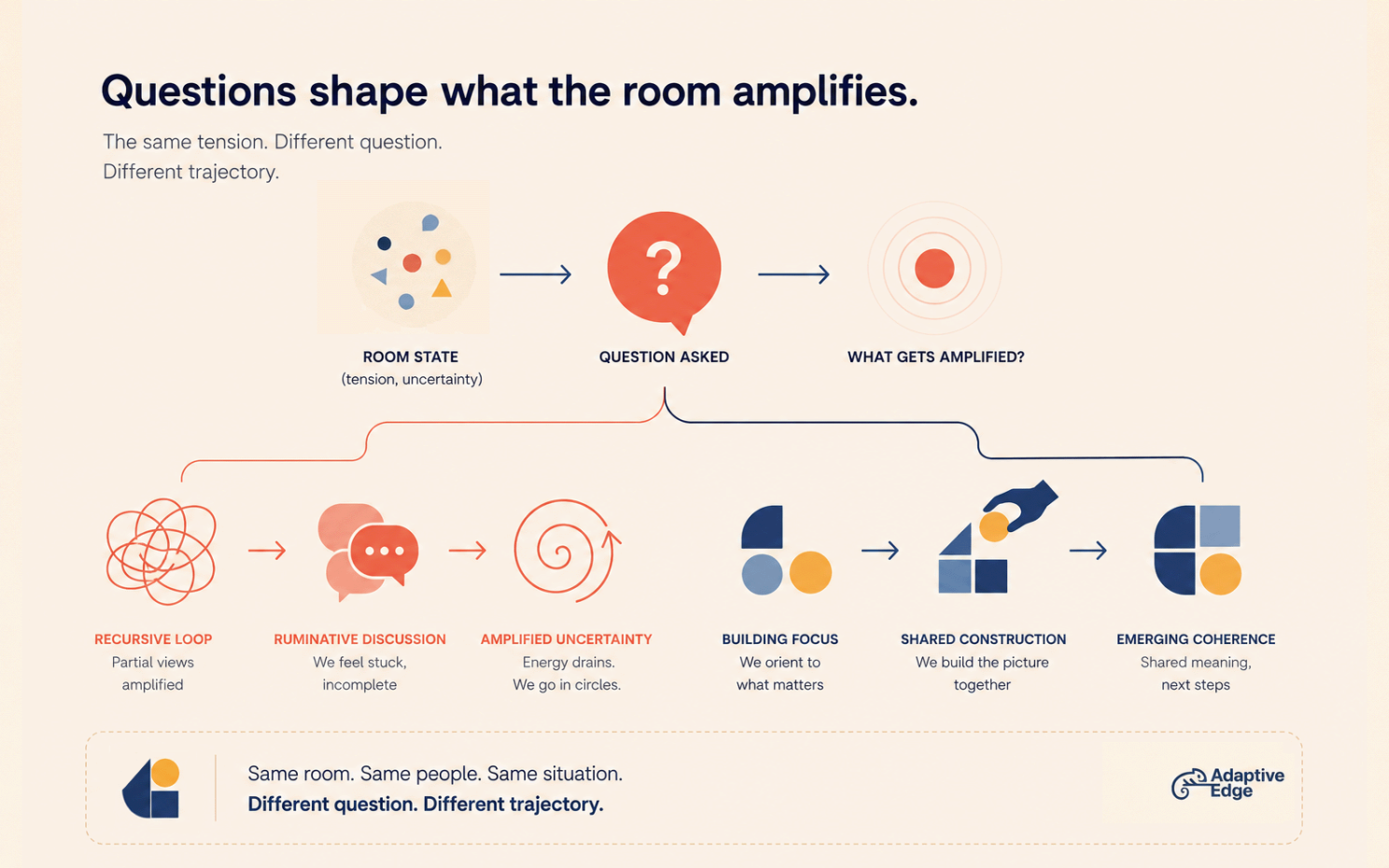
Asking "how was it for you?" in that state isn't really an invitation to reflect. It's an invitation to articulate the partialness people have just experienced. And once one person started, the room synchronised on that frequency. Forty-two partial views became one shared narrative of incompleteness.
By going straight into building the second time, I did something different. I showed them the picture on the box by getting them to assemble it. They didn't have to take my word for the fact that the pieces fitted. They could see them fitting in their hands.
Flipping the question
I wasn't the first to notice this. In 1980, a young doctoral student called David Cooperrider was conducting an organisational analysis at the Cleveland Clinic, one of the most respected medical institutions in the United States. He was using the standard approach of the time: asking people what wasn't working, diagnosing problems, feeding the findings back. What he noticed was that the more problems people surfaced, the more discouraged they became. The more discouraged they became, the more they blamed each other. The questions weren't producing insight, only despair.
So he flipped the inquiry. He started asking what was working at its best, listening for the stories of success rather than the catalogue of failures. The room shifted. The same people, the same institution, talking about the same work, became a fundamentally different kind of conversation.
That observation became the foundation of Appreciative Inquiry, which has since been used at Apple, Johnson & Johnson, Verizon, the United Nations and many others. Cooperrider, who I've had the good fortune to meet, has spent the last four decades arguing that organisations move in the direction of what they inquire into. Inquire into problems and you find more problems. Inquire into strengths and you find more strengths.
The room doesn't sit neutrally waiting to be discovered. It responds to the question.
The organisational theorist Karl Weick has been writing about something related for almost as long. Sensemaking, in his framing, isn't a passive interpretation of an experience that's already happened. It's something we do, in the moment, by speaking and behaving. As he famously put it: "How can I know what I think until I see what I say?" We enact the meaning of our experiences. Which means the questions we ask in the wake of an event aren't neutral lookbacks. They shape what the event becomes.
I've written before about Build to Think, the designer's principle that the act of making is itself a form of cognition. This is the same idea in a different register. The team in that second debrief weren't reflecting on whether the workshop had given them enough. They were finding out by trying to build with it. And in the process, they were learning that it had.
Questions as amplifiers
The broader pattern, which I'm still working out, is that questions are amplifiers of whatever energy is already in a room. They don't create their content; they release it.
Ask a tense room a reflective question and you amplify tension. Ask a stuck room a process question and you amplify the stuckness. Ask the same rooms a building question and you give them somewhere to put their energy that isn't recursive.
I've written before about the question divide: how, in a world where AI will give you almost any answer, the real divide is between those who know how to ask the right question. This is the room-level version of the same observation. Same principle, different setting.
This isn't a case for never asking how someone is. The reflective question is essential when there's space and trust for it, when energy is settled, when the meaning is genuinely up for grabs. But it makes a poor default. Most of us, myself included, reach for it without thinking about whether this is the moment for it.
It's worth pausing, before you ask, to read the room. Is the energy already pointing somewhere? Is there a partialness in the room that an open question will only deepen? Sometimes the right move is to give people something to do with their hands before you ask them what they think.
The room teaches you, if you let it.
Where have you noticed the timing or quality of a question changing the answer?